Master Swap Routes
Every DeFi swap involves a route. A route determines which provider handles the transaction, which network the swap runs on, how much the user receives after fees and slippage, and how long the swap takes to settle.
The problem is that most DeFi users do not compare routes before acting. They open one protocol, accept the first quote, and execute, without knowing whether a better option exists on another provider, another network, or through a different path.
This matters more than it used to. DeFi execution now spans dozens of networks, hundreds of token pairs, and multiple aggregation layers.
A user swapping ETH to USDC on Ethereum might get a meaningfully different outcome than the same swap routed through Arbitrum or Optimism.
A user swapping on Solana might find a faster settlement through one provider and a better price through another. Without a way to see these options side by side, users make decisions with incomplete information.
Sumex operates as a unified DeFi execution layer. Instead of opening separate protocol interfaces for each swap, users compare routes from multiple providers through one workspace.
As of now, Sumex has already become one of the largest routes aggregators and features such providers as LiFi, 1inch, OKX DEX, PancakeSwap, among many others - all from a unified interface, covering same-chain and cross-chain swaps across EVM, Solana, TON, Sui, and Stellar, without any extra costs to the end user.
The user sees the available routes, reviews the output, checks the provider, selects a network, and confirms the wallet, all before executing.
Steps
1. Connect a Wallet Bundle
Before comparing routes, connect a Web3 wallet through Connection Manager. The Wallet Bundle links the wallet to the user's Sumex account and enables DeFi execution workflows, including swaps, private swaps, liquidity, and lending actions.
Go to Connection Manager, add a wallet bundle, and follow the wallet connection flow. Confirm the wallet appears under connected sources.
2. Open the Swap interface
Navigate to the Swap tab under the Trade section on Sumex. Select the source token (the token being swapped) and the destination token (the token being received). Enter the amount.
3. Review the available routes
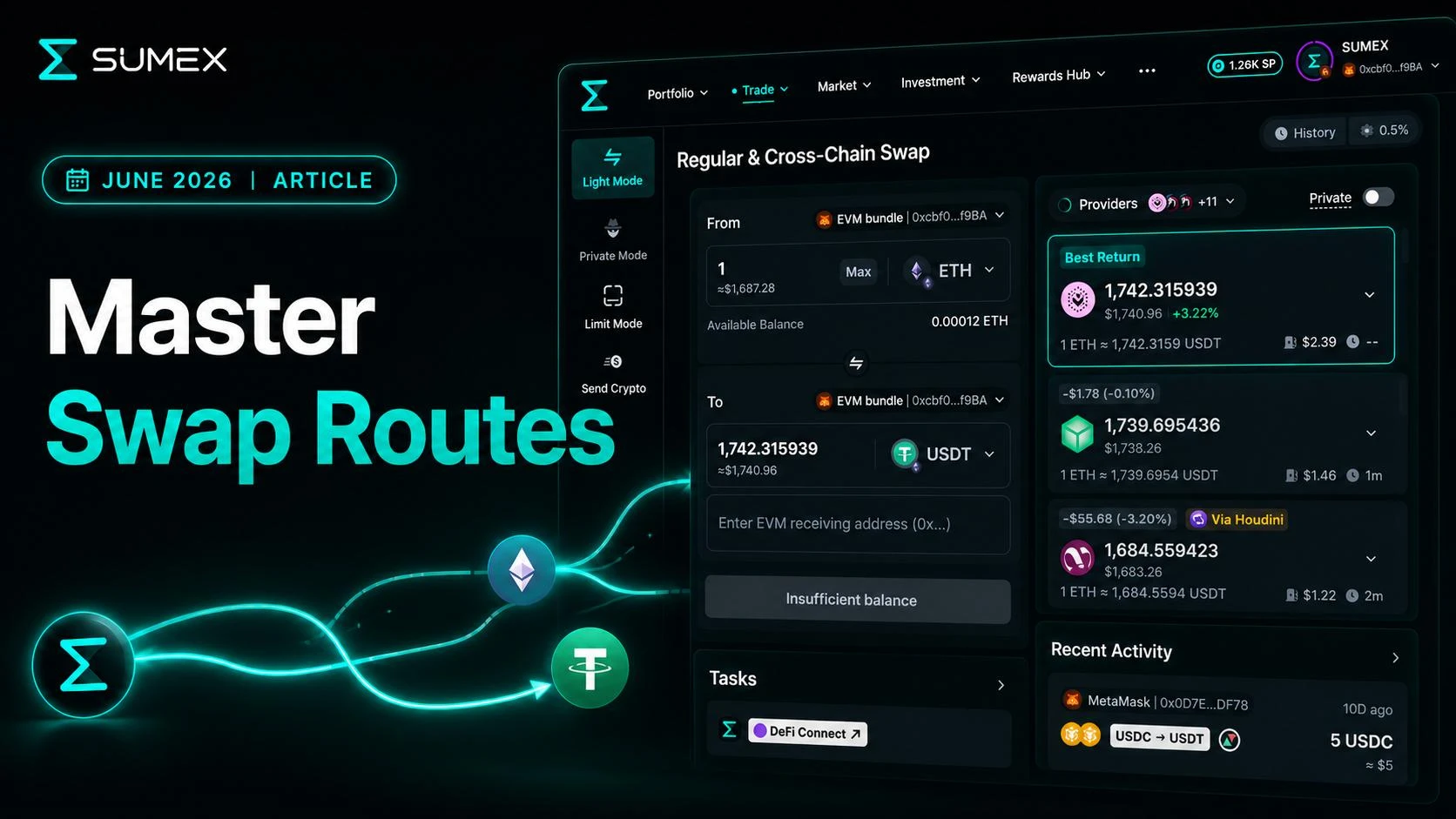
Sumex queries multiple route providers and returns available paths for the swap. Each route displays key information:
- Provider: The aggregator or protocol handling the route
- Estimated output: How much of the destination token the user receives
- Network: which blockchain the swap executes on
- Estimated fees and gas: The cost of executing the transaction on-chain
- Estimated time: How long the swap takes to settle
Review the routes side by side. Do not select the first route by default.
4. Compare across networks
If the same token pair is available on multiple networks, compare the output across chains. A swap on Ethereum mainnet may cost significantly more in gas than the same swap on Arbitrum, Optimism, Base, or Polygon.
A swap on Solana may offer faster settlement. A swap on TON or SUI may support tokens not available elsewhere.
The right network depends on where the user's tokens currently sit, which wallet is connected, and what the user intends to do with the destination token after the swap.
5. Check the provider context
Not every provider handles every token pair the same way. Some providers specialize in large swaps with deep liquidity pools. Others handle cross-chain swaps with bridge integrations. Some offer privacy-oriented routing.
If the swap requires privacy, consider using our Private swap feature. A provider-backed privacy-oriented swap experience available through the Sumex swap architecture.
6. Review slippage and execution details
Before confirming, check:
- Slippage tolerance: The maximum acceptable difference between quoted and executed price
- Minimum received: The lowest output the user accepts
- Approval status: Whether the source token requires a smart contract approval before the swap executes
Adjust slippage tolerance if the default does not fit the trade size or market conditions.
7. Confirm wallet and execute
Verify that the connected Wallet Bundle matches the intended source chain and holds the source token. Confirm the transaction in the wallet. Monitor the swap status until settlement.
Example
A user holds USDC on Ethereum and wants to swap to ETH. They open Swap on Sumex, enter the amount, and see three available routes: one through LiFi on the Ethereum mainnet, one through 1inch on Arbitrum, and one through Rubic cross-chain from Ethereum to Arbitrum.
The Ethereum mainnet route shows the highest output in ETH but also the highest gas fee. The Arbitrum route shows slightly less ETH but costs a fraction of the gas. The cross-chain route requires bridging, which adds time but delivers the ETH directly to the Arbitrum wallet.
The user compares all three. They intend to use the ETH on Arbitrum for a lending position, so the cross-chain route saves a separate bridge step later. They select it, review the slippage, confirm the wallet, and execute. After settlement, they verify the ETH arrived in the correct wallet on Arbitrum.
Without route comparison, this user would have swapped on the Ethereum mainnet, paid higher gas, received the ETH on the wrong chain, and then needed a separate bridge transaction, costing more time and more fees.
Common Mistakes
Accepting the first route without comparing. Most DeFi users open one protocol and execute immediately. They do not check whether a different provider offers better output, a different network offers lower gas, or a cross-chain route avoids an extra bridge step later.
A second common mistake is choosing a route based on output alone without checking the network. A route may show the highest token output, but if it delivers the tokens to a chain the user does not intend to use, the user ends up needing additional transactions to move the tokens where they are actually needed.
When Not To Do This
- Do not swap tokens on unfamiliar protocols just because a route exists. If the provider, network, or token is unfamiliar, research it before executing. Sumex displays routes from multiple providers, but route availability does not equal safety endorsement.
- Do not execute large swaps during extreme market volatility without adjusting slippage tolerance. Default slippage settings may not protect the user during rapid price movement.
- Do not approve unlimited token spending on smart contracts without understanding the approval. Review the approval amount before confirming in the wallet.
- Do not ignore the wallet and network confirmation step. Sending a swap from the wrong wallet or to the wrong chain creates recovery problems that are difficult or impossible to reverse.
Checklist
- Wallet Bundle connected through Connection Manager
- Source token, destination token, and amount entered in the swap
- Multiple routes reviewed and compared, not just the first one selected
- Network checked, source chain and destination chain match the intended use
- A private swap is considered if privacy is needed
- Slippage tolerance reviewed and adjusted if necessary
- Token approval checked before execution
- Wallet confirmed: correct wallet on the correct chain holds the source token
- Swap executed and settlement status monitored
Swap Routes FAQ
What is a crypto swap route?
A swap route is the execution path used to exchange one crypto asset for another. It determines which provider handles the transaction, which blockchain the swap executes on, the estimated output, fees, and settlement time.
Why should I compare multiple swap routes?
Different providers and networks can produce different outcomes for the same swap. Comparing routes helps optimize token output, reduce gas fees, shorten settlement time, and avoid unnecessary bridging transactions.
Does Sumex charge extra fees for route aggregation?
No. Sumex aggregates routes from multiple providers through a single interface without adding additional costs for route comparison.
Can Sumex perform cross-chain swaps?
Yes. Sumex supports both same-chain and cross-chain swaps across multiple ecosystems, allowing users to compare routes from various providers and execute swaps from a unified interface.
What should I check before confirming a swap?
Before executing a swap, review the selected provider, destination network, estimated output, gas fees, slippage tolerance, minimum received amount, and any required token approvals to ensure the transaction matches your intended outcome.